Design Philosophy
Weaver’s mission is to help software engineers design complex hardware systems without the need for deep hardware expertise.
Hardware Is Hard
Software is sequential. Each statement executes one after another. Even with threads or async/await, there is an underlying sequential execution model. People naturally reason this way.
Hardware is different. Many operations occur at the same time: a processor may fetch one instruction, decode another, execute a third, and write back a fourth, all simultaneously. Parallelism is not optional; it is the nature of hardware.
Traditional hardware description languages embrace implicit parallelism: everything happens at once unless you explicitly sequence it using state machines or control logic.
This creates a cognitive mismatch. People reason sequentially, but are forced to design in a fully parallel model. As a result, designers must maintain two descriptions of the same system:
- a behavioral model that people can understand, and
- a structural implementation that the compiler can synthesize.
Bridging these two descriptions requires extensive testing and verification, consuming much of the effort in modern chip design.
Alternatively, High-Level Synthesis tries to compile software programs to hardware, but it is very easy to write a program that is not synthesizeable.
Software is virtual: functions are loaded and unloaded, memory is allocated and deallocated, network connections are created and destroyed, nothing occupies physical space. Hardware is physical: functions, memory, and connections are all implemented by real, physical, concrete circuit elements.
Virtualization hides sequencing and dependency through memory, and how everything is organized in memory over time is dependant on the inputs of the program. By definition, the compiler does not have enough information to untangle virtualization at compile time.
Introducing Weaver
Weaver is fundamentally sequential and physical.
It provides a sequential execution model that people can reason about while mapping directly to physical hardware.
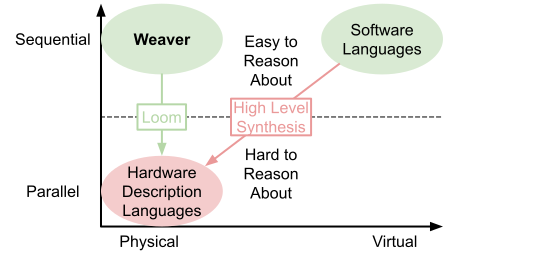
Weaver looks and feels like a modern software language, abstracting the hardware-level semantics into a more familiar execution model. This drives several key design choices:
-
Behavior First - Describe what the system should do, not how signals move between registers each cycle. The compiler handles the low-level details.
-
High Level Abstractions - Stop worrying about encodings, protocols, or timing. The model and implementation are unified, and verification is built in.
-
Composable Design - Components communicate through explicit channels with built-in flow control and validity. Parallel composition explicit and predictable, avoiding the hidden dependencies common in shared-memory models and the subtle timing bugs common in register-transfer logic.
Hardware Semantics
Weaver describes hardware, not software.
-
Physical, not Virtual - Functions, memory, and connections exist as real, concrete hardware elements. Resources are static, functions are inlined, and processes run as long as the chip is powered.
-
Fine-Grained Parallelism - Hardware executes many operations simultaneously.
This has many downstream consequences.
-
Validity, not Locks - Weaver uses a lighter mechanism to manage distributed access shared resources.
-
Native Parallel Composition - Weaver provides native operators and semantics to interleave sequential, parallel, and conditional execution safely.
-
Message Passing, not Shared Memory - In Weaver, computation is expressed as long-lived processes rather than ephemeral software functions. Processes maintain state across time, communicate across channels, and execute continuously while the chip is powered.
Balance of Power and Simplicity
Because Weaver describes hardware, it is built up from semantics that are very different from software. As a result, there are many powerful low-level semantics in the language. However, those semantics are often both complex and complicated in extremely subtle ways.
Weaver tries to balance expressive power with simplicity through abstraction. You may pick up Weaver and make it look like any other programming language. Or, with a healthy dose of psychodelics and masochism, you too can join us down the rabit hole of event semantics, timing models, handshake protocols, non-determinism, and the beautifully woven hyperdimensional fractal that is a program.
Until then, the language is powerful enough to describe complex architectures, but simple enough that software engineers can learn it without deep hardware expertise.
What This Means for You
When designing with Weaver, keep these principles in mind:
- Think in hardware - Your code describes physical circuits, not running programs.
- Design top-down, Build bottom-up - Understand the bigger picture, but build and verify the smallest and simplest process first.
- Minimize data movement - Prefer point-to-point communication over broadcast, feed-forward algorithms over iterative, distributed architectures over centralized, and small data packets over big.
- Minimize energy - Avoid unnecessary work and take advantage of sparse or irregular data.
Understanding these principles helps you write Weaver code that’s not just correct, but also clear, maintainable, and well-architected.